2.4/5GHz WiFi Antenna
2.4/5GHZ WiFi antenna solutions combining wide coverage and high-speed performance for modern wireless networks.
Dual Frequency
Supports both 2.4GHz and 5GHz
bands
Balanced Performance
Combines coverage and speed
System Integration
Simplifies system integration
Flexible Deployment
Adaptable to different network environments
Overview
Dual-Band WiFi Antenna Solutions
Dual-band WiFi antennas support both 2.4GHz and 5GHz frequency bands in a single solution, allowing wireless systems to balance coverage and performance requirements.
The 2.4GHz band provides wider coverage and better penetration, while 5GHz delivers higher speed and lower interference.
Therefore, dual-band antennas are ideal for environments that require both reliable connectivity and efficient data transmission.
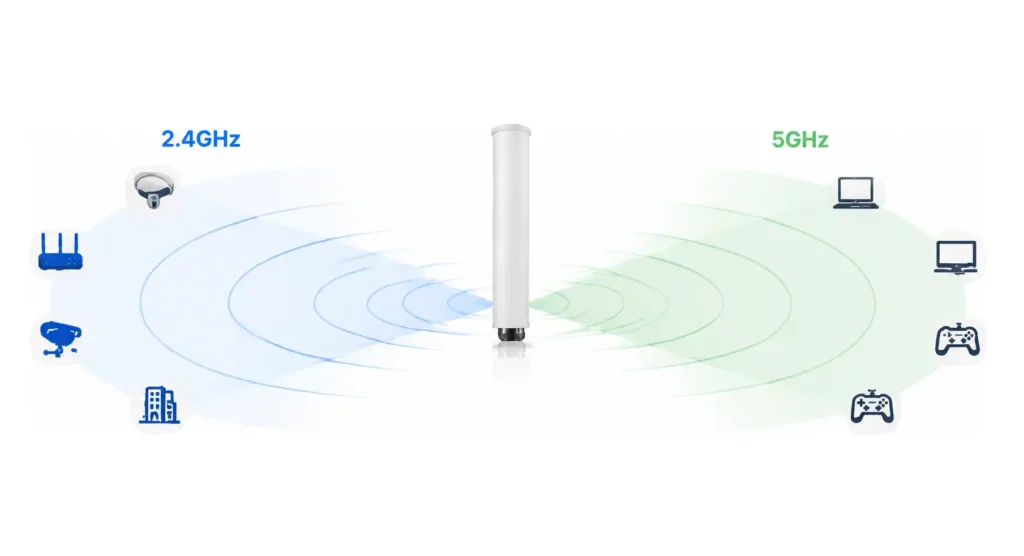
Why Choose Dual-Band WiFi Antenna
2.4GHz Advantage
Wider Coverage
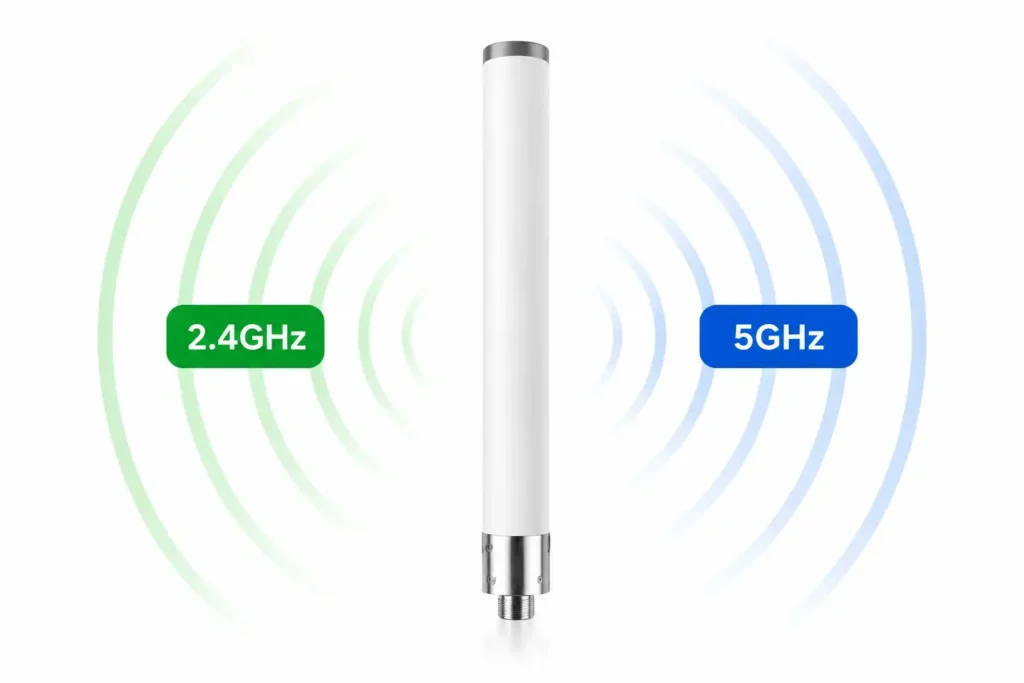
Provides wider signal coverage and stronger penetration, making it suitable for larger areas and environments with obstacles.
Better Penetration
Performs better when signals need to pass through walls or physical barriers.
5GHz Advantage
Higher Speed
Supports faster data transmission for bandwidth-intensive applications such as video and high-speed wireless connections.
Lower Interference
Offers more available channels and reduced interference in crowded wireless environments.
One Antenna,Two Frequencies,More Possibilities.
Dual-band antennas allow networks to balance coverage and performance by using the most suitable frequency for different devices and applications.
HOW DUAL-BAND TECHNOLOGY WORKS
One Antenna Supporting Two Frequency Bands
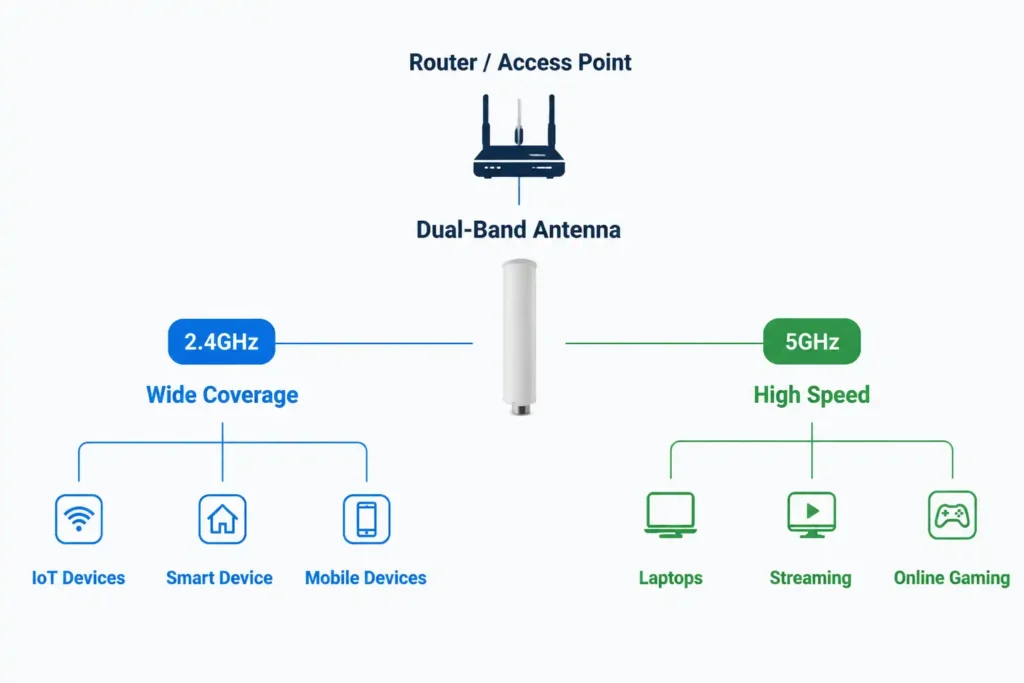
A dual-band WiFi antenna supports both 2.4GHz and 5GHz frequency bands, allowing wireless devices to connect through the most suitable frequency based on coverage and performance requirements.
2.4GHz
- provides wider coverage and stronger penetration.
- ideal for connecting devices in long-range or complex environments.
5GHz
- delivers higher speed and lower interference.
- ideal for high-bandwidth applications and performance-critical tasks.
By supporting both frequency bands within one antenna system, dual-band antennas provide greater flexibility for different wireless environments and device requirements.
Use Scenarios
Enterprise Networks
Stable dual-band connectivity for office environments
Video Surveillance
Reliable transmission for monitoring systems
Wireless ISP
Flexible deployment for service providers
Campus Networks
Large-area hybrid wireless coverage
Industrial Systems
Stable communication in complex environments
Outdoor Deployment
Robust performance in outdoor conditions
TECHNOLOGY COMPARISON
FEATURE
- Coverage
- Speed
- Penetration
- Interference
- Channels
2.4GHZ
Wide
Medium
Strong
High
Long Range Coverage
5GHZ
Medium
High
Weak
Low
High Speed Links
2.4/5GHZ
Balanced
Adaptive
Flexible
Balanced
Dual-Band Networks
dual-band TYPES
2.4/5GHz WiFi Antenna
Omni-directional WiFi Antenna
360° coverage for dual-band wireless networks.
Suitable for: Office / Indoor Network
2.4/5GHz WiFi Antenna
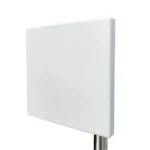
Panel wiFi Antenna
Directional high-gain transmission for stable links
Suitable for: Wireless Bridge
2.4/5GHz WiFi Antenna
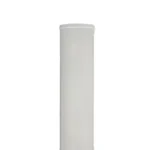
Sector WiFi Antenna
Weather-resistant wireless connectivity solution
Suitable for: WISP / Base Station
FAQ – 2.4/5GHz WiFi Antenna
Understanding Dual-Band WiFi Antennas
Selecting the Right Dual-Band Antenna
A dual-band WiFi antenna is designed to support both 2.4GHz and 5GHz frequency bands within one antenna system. Compared with single-band antennas, it provides more flexibility by balancing wider coverage and higher-speed wireless performance. The 2.4GHz band is suitable for longer-range connections and better penetration, while the 5GHz band supports faster data transmission with lower interference. Therefore, dual-band antennas are widely used in applications that require both reliable coverage and efficient network performance.
The main advantage of a dual-band antenna is that it combines the strengths of both frequency bands. The 2.4GHz band provides wider coverage and stronger penetration, making it suitable for larger areas or environments with obstacles. On the other hand, the 5GHz band offers higher speed and reduced interference for bandwidth-intensive applications. As a result, one dual-band solution can support different devices and network requirements more efficiently.
Yes, a dual-band antenna can support both 2.4GHz and 5GHz frequency bands through a single antenna design. However, actual performance depends on the wireless equipment, antenna structure, and network configuration. In most cases, dual-band solutions allow connected devices to use the more suitable frequency based on coverage, speed, and application requirements. This flexibility makes them a practical choice for modern wireless networks.
A dual-band antenna is a better choice when your network needs both coverage reliability and high-speed performance. For example, enterprise networks, industrial systems, and outdoor wireless deployments often require different frequency characteristics for various devices. In contrast, a single-band antenna may be sufficient for applications with fixed performance requirements. Therefore, dual-band antennas are recommended when network environments include multiple devices, different distances, or changing connectivity demands.
Dual-band WiFi antennas are suitable for a wide range of wireless applications, including enterprise networks, video surveillance, industrial communication, wireless bridges, and smart devices. For instance, 2.4GHz can provide stable coverage for IoT equipment, while 5GHz can support higher-bandwidth applications such as video transmission. In addition, dual-band solutions are useful in environments where multiple devices require different levels of wireless performance.
Choosing the right dual-band antenna depends on several factors, including coverage area, installation environment, communication distance, and application requirements. First, consider whether you need wide-area coverage or focused directional transmission. Then, evaluate antenna type, gain, mounting position, and cable selection. In addition, understanding the operating environment helps ensure better signal performance and long-term network reliability.
Need a reliable dual-band WiFi Antenna Solution?
Contact our team for customized dual-band antenna solutions for wireless networks, access points, and industrial applications.
Expert Support
Engineering team support for antenna selection and deployment guidance.
Custom Solutions
Tailored antennas for your applications.
Reliable Quality
Strict quality control ensures stable and long-term performance.
Fast Response
Quick technical support and quotation response within 24 hours.